

BASALT AGGREGATE IMPORT

HIGHWAY LAMPPOST INSTALLATION

TRAFFIC SIGNS AND ROAD MARKING

DIRECTIONAL SIGNING

SLIPFORM PAVER

EMERGENCY MAINTENANCE AND DRAINAGE WORKS
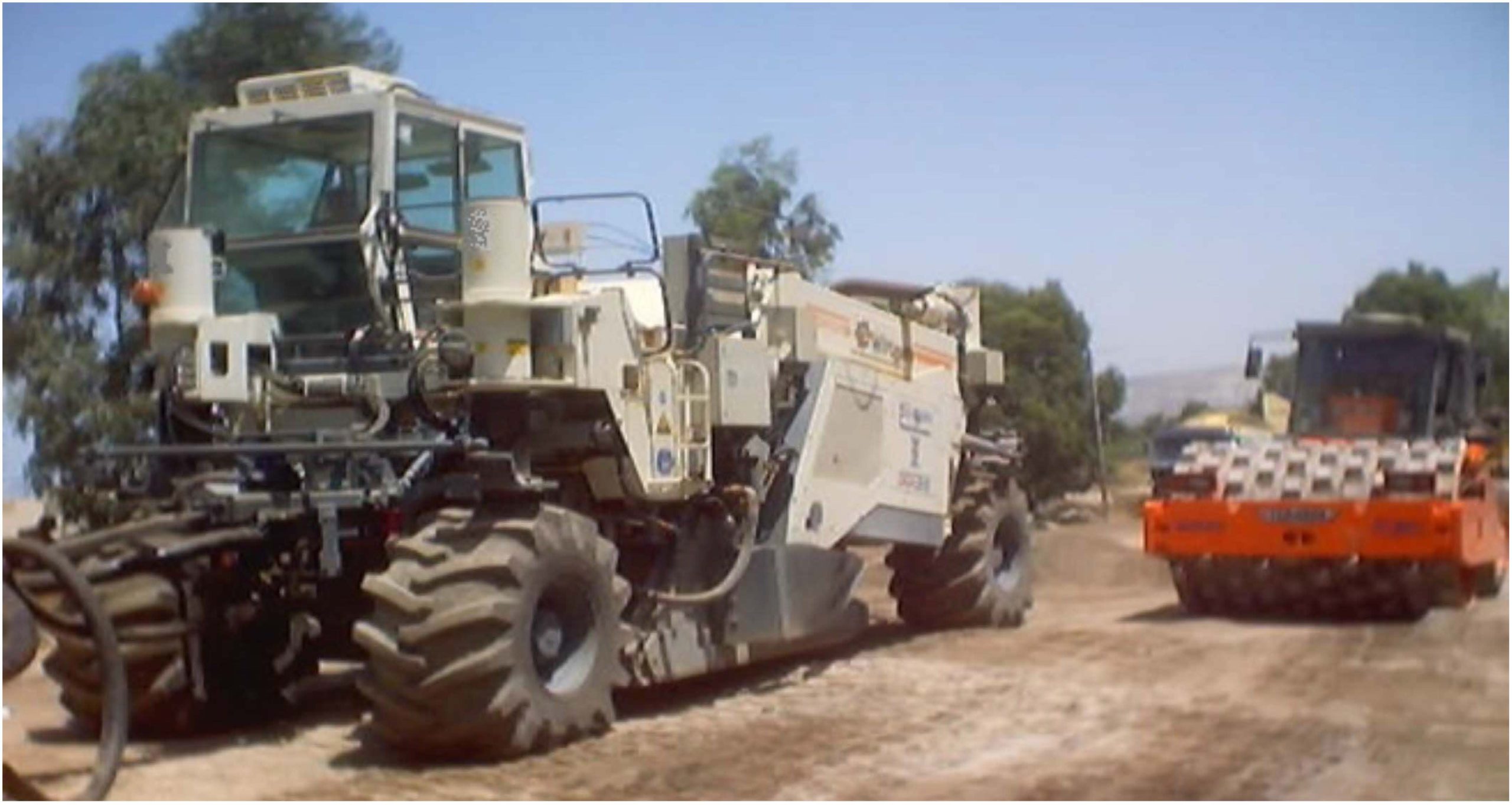
COLD IN PLACE RECYCLING AND MILING
Implementation of this belief was achieved by the introduction of a complete new set of equipments by German maker “WIRTGEN” consisting of several synchronized machines that maintain and restore damaged highway strips by using the method of “cold recycling system” and they also are unrivaled for soil stabilization. First they scalp defined thickness of the upper layer of the asphalt pavement then recycle this layer with moisture of cement, tar and water to produce a new high strength layer with capacity of rehabilitating 5000m2 of roads in 8 working hours. As efficient as this might be to the client, this technology took considerable amounts of investments millions of dollars to employ. Up to this date Antoine Makhlouffor Trading and Contracting is proudly the only company in Lebanon to propose such technology and machines.
Cold in-place recycling benefits:
- High performance daily system that is incomparable to conventional methods.
- Do not disturb the traffic circulation, avoid local diversions.
- Practical during rainy seasons.
- Normally only one layer of asphalt is sufficient to protect the surface against high-speed traffic.
- Suitable process to the underground facilities. In case of facing shallow underground facilities, a few centimeter of base material should be spread on the top to make the road suitable for recycling. Upgrading the road elevation, especially in the rural areas, should be considered.
- Immediately open the traffic after finishing the compaction.
- Decreasing the water susceptibility on the in-situ material.
- Application to a wide range of material.
- Increasing material shear strength.
- Increasing the in-situ CBR of the sub-base.
- Preserving initial level of the road.
- Modifying cross and longitudinal road profile.
- Strength characteristics approach that of cement treated materials, while remaining flexible and hence relatively fatigue resistance.
- Using materials classified as unsuitable or low quality in conventional methods.
- Producing no environmental pollution by using insitu asphalt.
- Using in-situ material leads to precious natural resources preservation.


Implementation of this belief was achieved by the introduction of a complete new set of equipments by German maker “WIRTGEN” consisting of several synchronized machines that maintain and restore damaged highway strips by using the method of “cold recycling system” and they also are unrivaled for soil stabilization.
First they scalp defined thickness of the upper layer of the asphalt pavement then recycle this layer with moisture of cement, tar and water to produce a new high strength layer with capacity of rehabilitating 5000m2 of roads in 8 working hours. As efficient as this might be to the client, this technology took considerable amounts of investments millions of dollars to employ. Up to this date Antoine Makhlouf for Trading and Contracting is proudly the only company in Lebanon to propose such technology and machines.
- High performance daily system that is incomparable to conventional methods.
- Do not disturb the traffic circulation, avoid local diversions.
- Practical during rainy seasons.
- Normally only one layer of asphalt is sufficient to protect the surface against high-speed traffic.
- Suitable process to the underground facilities. In case of facing shallow underground facilities, a few centimeter of base material should be spread on the top to make the road suitable for recycling. Upgrading the road elevation, especially in the rural areas, should be considered.
- Immediately open the traffic after finishing the compaction.
- Decreasing the water susceptibility on the in-situ material.
- Application to a wide range of material.
- Increasing material shear strength.
- Increasing the in-situ CBR of the sub-base (stabilization).
- Preserving initial level of the road.
- Modifying cross and longitudinal road profile.
- Strength characteristics approach that of cement treated materials, while remaining flexible and hence relatively fatigue resistance.
- Using materials classified as unsuitable or low quality in conventional methods.
- Producing no environmental pollution by using in-situ asphalt.
- Using in-situ material leads to precious natural resources preservation.


